Cockroach Robot
Traditional robots navigate cluttered environments by detecting obstacles and planning a collision-free path around them, an approach that fails when obstacles are close to the robot's own size and densely packed. This project instead uses body shape and passive compliance to roll through obstacles rather than avoid them, an approach modeled as movement across a potential energy landscape with distinct locomotor modes. A closed-loop control algorithm uses real-time motor current and speed feedback to detect when a leg has jammed against an obstacle, then coordinates the robot's legs to roll past it, currently achieving an 85 percent success rate as tuning continues. The robot is now being fitted with CoinFT, a 6-axis force/torque sensor, to directly measure the forces involved in rolling and build a real, data-backed picture of that energy landscape.
Terradynamic Streamlining
- Traditional obstacle navigation maps geometry and plans a path around obstacles, which fails when obstacles are roughly the robot's own size and spaced closer than its width
- This approach instead uses the robot's body shape and compliance to physically interact with obstacles, rolling into gaps rather than avoiding contact
- Modeled as movement across a potential energy landscape with basins corresponding to different locomotor modes: a high-energy pitch mode (pushing straight into obstacles) and a lower-energy roll mode (rotating onto its side to pass through)
- An energy barrier separates these two modes; crossing it requires additional work from the robot's tail and legs
Closed-Loop Jam Detection and Recovery
- Real-time motor current and speed feedback detects when a leg has jammed against an obstacle, identified by a leg turning at a fraction of its commanded speed while drawing high current, sustained over a short window
- Once a jam is detected, the front leg motor reverses at a slower speed, letting its hook catch the obstacle and pull the robot forward
- The back leg motor stays disabled by default to preserve balance, re-engaging only once the front leg completes a full forward revolution
- The cycle of jam, reverse, cooldown, and forward repeats as needed until the robot passes through
Results
- Currently achieving an 85 percent success rate, with ongoing tuning of tail-swinging parameters for more consistent rolling
Integrating CoinFT: Toward an Energy Landscape
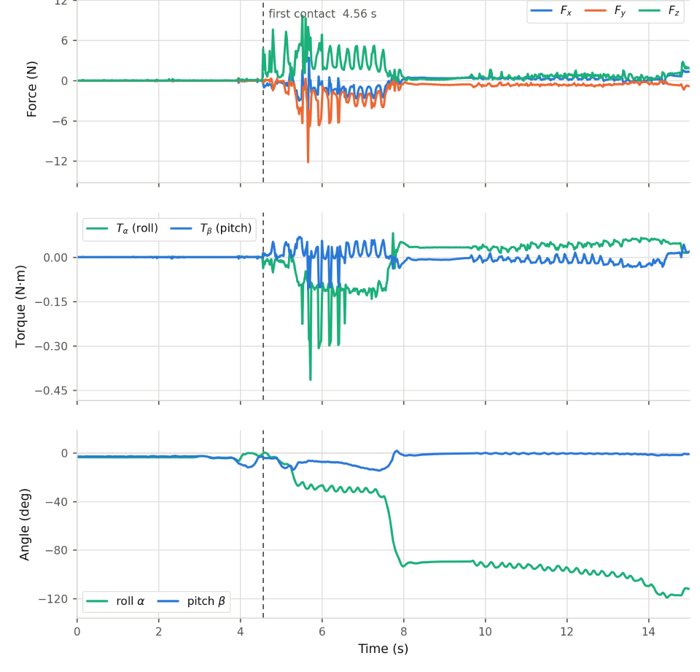
- CoinFT is now mounted on the robot to measure real 6-axis force and torque during rolling maneuvers
- Initial tests plotted 3-axis force, 3-axis torque, and IMU-derived body roll angle on a shared time axis to see how contact forces evolve through a rolling maneuver
- Testing surfaced a real hardware problem: the sensor has experienced delamination, prompting a redesign of how it is mounted to the robot for reliability
- Once mounting is resolved, this data will support full energy landscape plots, quantifying the potential energy barrier described above directly from measured forces rather than modeling it indirectly
Upcoming: resolving the sensor mounting to prevent delamination, then collecting the detailed force and torque data needed to construct a full, measured energy landscape for the robot's obstacle-crossing behavior.